The workers who made nothing
When the highway to the outside world went in, the town’s shop prices started to creep up. Groceries rose about 14% over a year, roughly three times as fast as before the highway, with no tax change and no shock. This entry is the hunt for why, and the one-line answer.
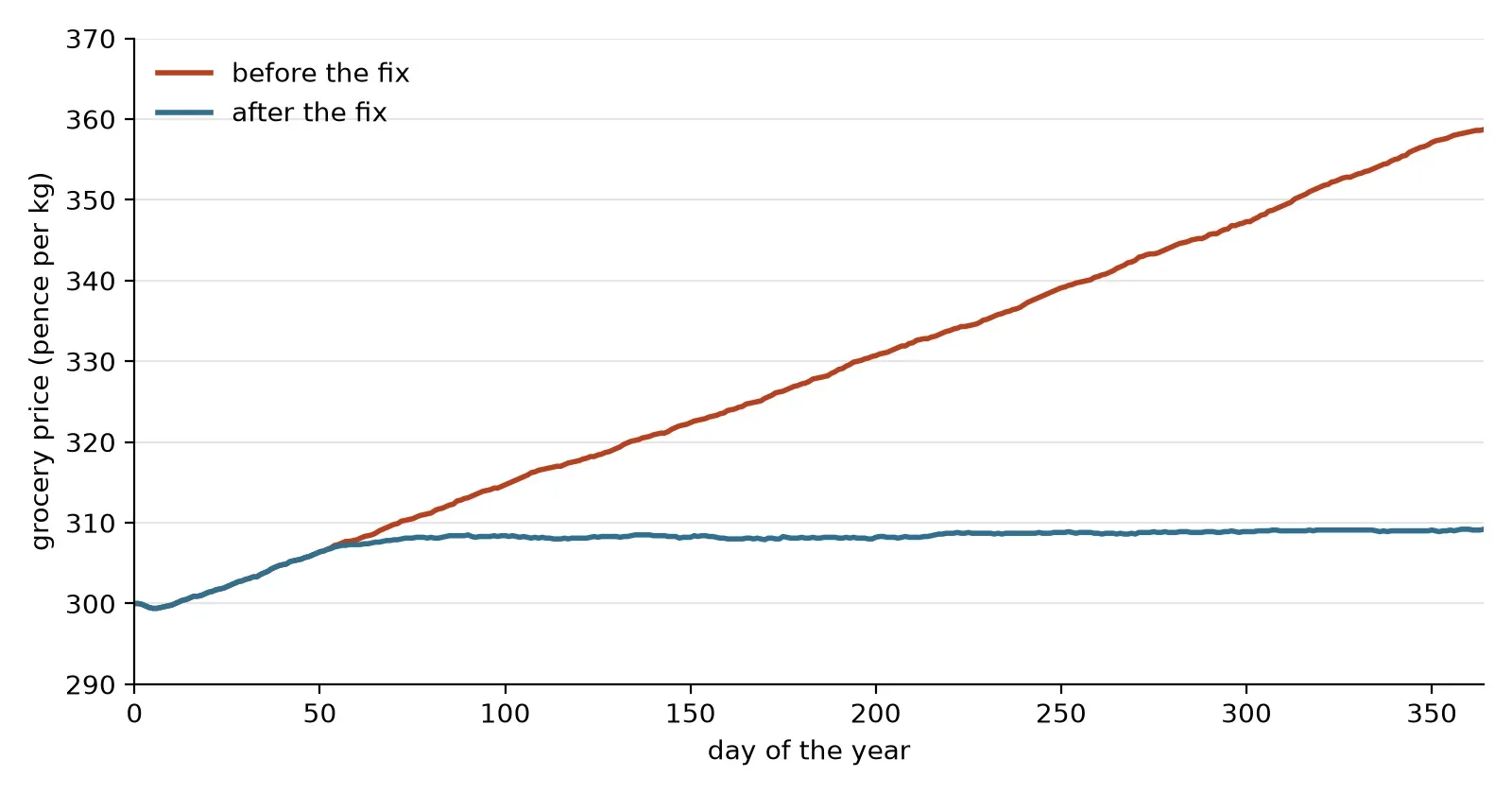
The same town, same seed, same year, on the code before the fix and after it. The lines match until about day 55, then split. Both are real runs, drawn from the game’s own metric files.
The obvious suspect
The highway lets residents take jobs outside the town, and outsiders take jobs inside it. The first guess was the labour market: if residents commute out, the town has fewer workers, shops have a harder time hiring, and prices rise. That was the explanation we had written down.
Splitting the runs
To test it we ran the town five ways, five seeds each, switching the two directions of commuting on and off separately:
| Run | Groceries’ yearly rise | Jobs left open |
|---|---|---|
| No commuting at all | about 1.6% | 18 |
| Residents commute out only | about 2.6% | 60 |
| Outsiders commute in only | about 11% | 5 |
| Both, as shipped | about 14% | 18 |
The residents-out run is the one with the tightest labour market of all: three times as many open jobs as the shipped town. Its prices hardly move. The outsiders-in run has the loosest market, and its prices drift almost as much as the full town’s. The labour market was innocent. The drift came from the workers arriving, not the workers leaving.
Paid, but never counted
An outsider who fills a vacancy is hired and paid like anyone else, and the job board treats the opening as filled, so it stops looking for a resident. But the shops’ production planning only counted residents. A grocer with outsiders on the payroll planned and produced as if they weren’t there: they cost wages and made nothing.
So the grocers stayed a little short of stock, from about day 60 on. The price rule reads stock below target as scarcity and raises the price a little every day. Nothing ever refilled the shelves, so the price never stopped rising. It reached groceries, produce and personal services, anything the town buys from its own shops.
The fix
Shops now count the outsiders working for them, their hours and their wages, as staff. That is the whole change. In seed 1 the grocery price on day 90 is 313 pence a kilo before and 309 after, and on day 360 it is 358 before and 309 after. Across 30 seeds, the groceries’ yearly rise went from a median of about 14% to about 1%, the grocery shortages that some seeds showed went to zero, and employment stayed where it was (98.7% against 98.8%). Personal services now drift slightly down instead of up, which the price rule allows.
A town that has no outside workers is bit-for-bit unchanged, so nothing else moved. Several quality checks that had been loosened to carry the drift were tightened back.
Next
Outskirts industry is next on the list, and its new firms would have been staffed from the same job openings, so they would have inherited the same bug. That was the reason to fix this first.