Shopping for a whole town
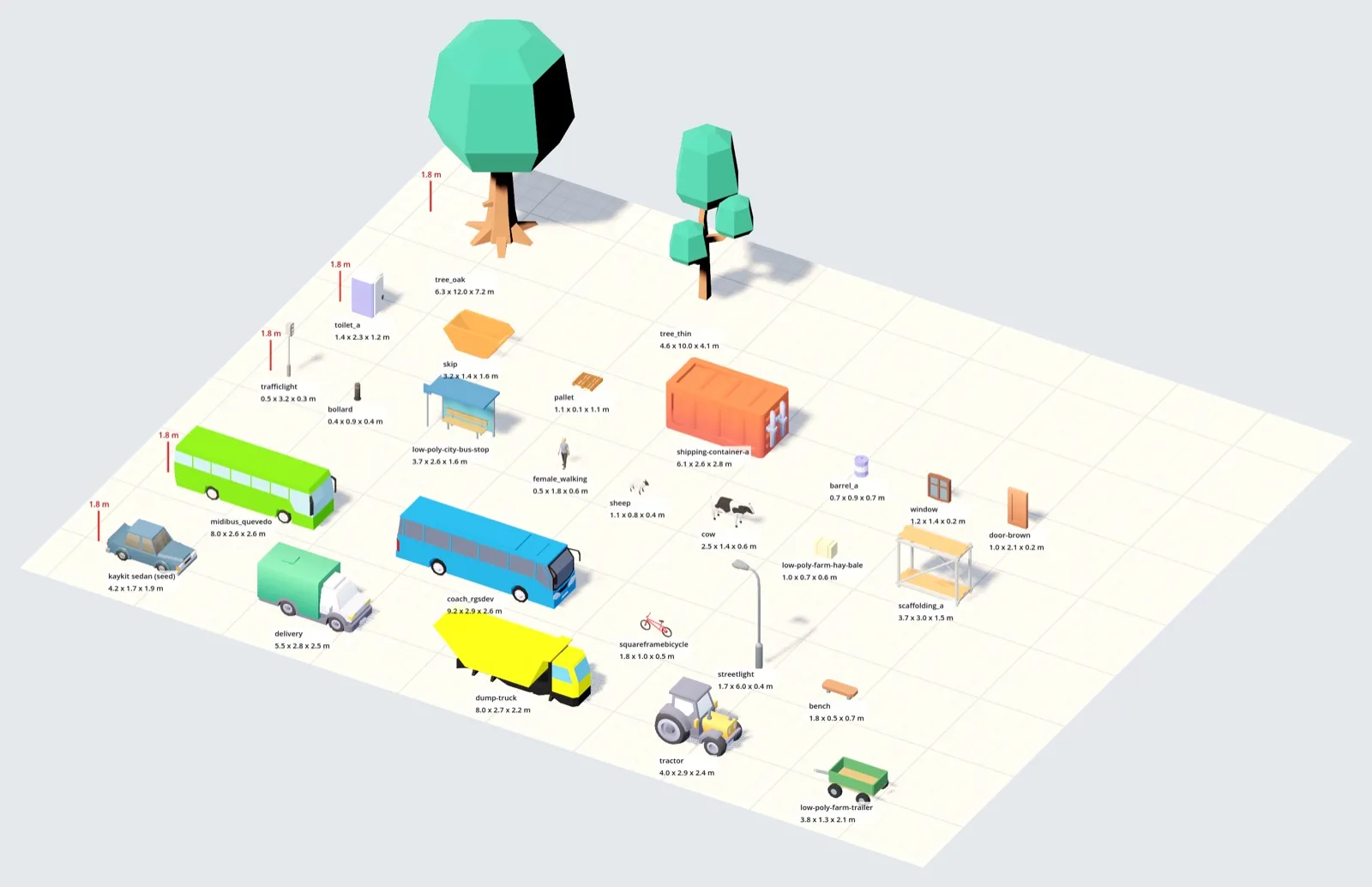
Some of the 82 models I picked, all at real size. The small blue car at the front left is one of the cars the game already draws, as a yardstick. Look at how the van, the coach and the tractor sit beside it: the same chunky, clean shapes. A few colours are still too loud, like the lime bus and the yellow tipper; more on that below.
The goal of this post: find free 3D models for everything a working town needs to show, from delivery vans and scaffolding to sheep and bus shelters, keep only the ones that look like they belong in one game, and be clear about what’s still missing.
Last time the game learned to draw trees, bushes, rocks and cars from ready-made models. That was two packs and a handful of kinds of thing. Since then the town has grown building sites and, out by the highway, factories, a haulier, a waste depot and a farm, which the game draws for now with shapes it builds itself; lorries carrying goods between them are on the way. All of that needs something better to draw. These models are placeholders, not the game’s final art, and almost none of them are in the game yet: the client can only draw trees, ground cover and cars from models today, and it has to be taught each new kind of model before it can use them. Every picture below is a real render from a small tool I wrote to look at models, not a game screenshot and not AI-generated.
A note on who did what: AI assistants did the legwork. They searched, downloaded, rendered the sheets you see here and made a first-pass style review of every one against written rules. I looked at the results, and the final call on every model is mine.
The wish list
I wrote down what the town will need, from the simulation’s own point of view:
- Vehicles: vans, rigid and articulated lorries, a flatbed, a tipper, a mixer, a crane truck, a bin lorry, a tractor with a trailer or a combine, buses and coaches, a hearse and bicycles.
- Building parts: the town’s buildings are built by the game, so windows, doors, chimneys, drainpipes, awnings and balconies matter more than whole houses.
- Industry and farms: pallets, containers, a forklift, silos and pipes, hay bales, crops, hedges, gates, sheep and cows.
- Construction sites: scaffolding, a crane, a site cabin, fencing, a mixer, piles of bricks, sand and timber.
- Streets: lamps, traffic lights, bus stops, benches, bollards, bins, post boxes, phone boxes, signs.
- People and nature: pedestrians, cyclists, field trees such as oak and ash.
The setting is a British town, so where there was a choice I looked for the red post box and the red phone box.
The rules
Only models that are free to use in a game are allowed: CC0 (no strings), or CC-BY (free, but the author must be credited, which I am glad to do). Nothing non-commercial, nothing share-alike, nothing unclear. Beyond the licence, a model has to pass four tests:
- One family. It has to sit next to the Kay Lousberg models from last time: chunky, clean, flat-shaded, soft colours, no photographic detail.
- Tintable. The game recolours things from the town’s palette, so a model with a few flat colours or one tiny colour strip works well, and one with a painted texture does not.
- Real proportions. Everything is drawn at real size: a car about 4.3 metres, a storey about 3, a door 2.1, a person 1.75. Toy proportions are fine only if the whole family shares them.
- Readable from far away. The camera sits tens to hundreds of metres from the town, so shape beats detail, and models have a triangle budget.
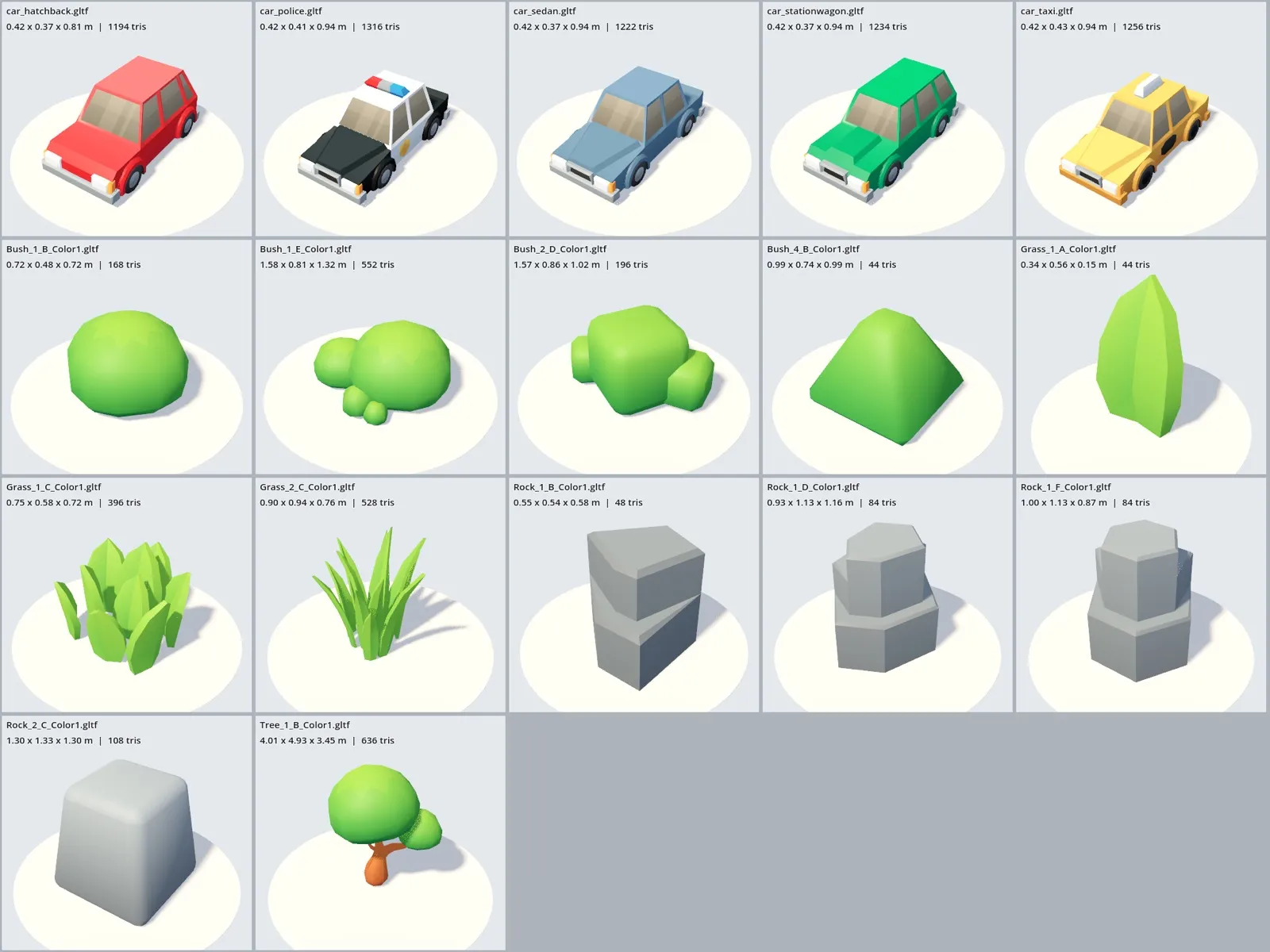
The yardstick for everything else: the two Kay Lousberg packs from last time, drawn the same way as every candidate. Soft bevels, flat colour, nothing busy. (Sizes in the labels are the files’ raw units, not metres.)
Casting a wide net
I looked at about 46 sources: 20 kits from Kenney, 2 from KayKit, 23 from Quaternius, single models from Poly Pizza, OpenGameArt, two authors on itch.io and the Innerscene library. Every candidate was converted to one format and drawn on a contact sheet, about 115 of them in all, each model on its own stand with its size and triangle count under it.
Looking is what sorts them. Here are two packs side by side. The first is Kenney’s modular buildings: plain walls, big flat glazing, a few dozen triangles per piece. It goes straight in.
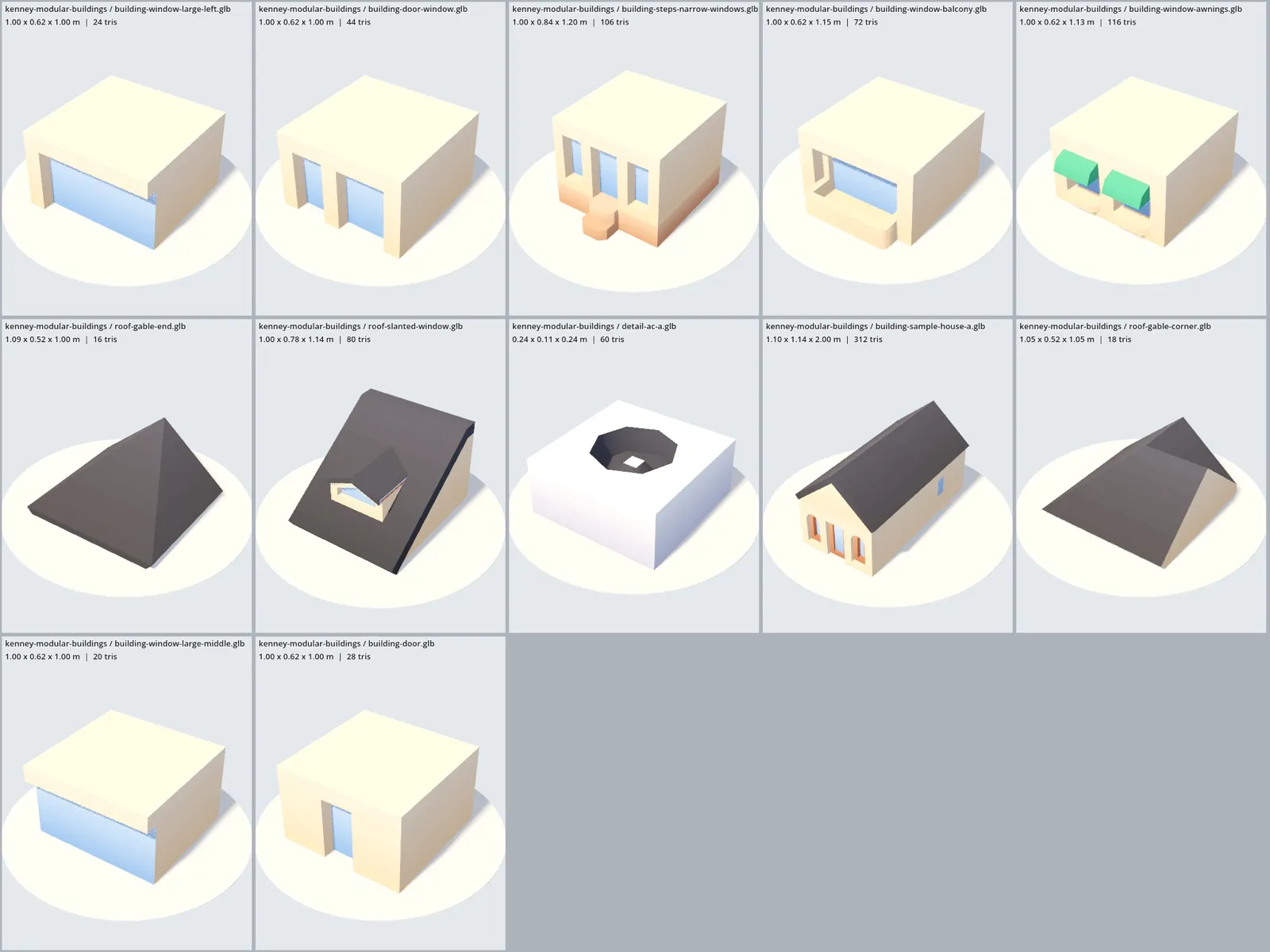
A pack that passed: cream walls, soft blue glass, no surface texture. Each piece is between 16 and about 300 triangles.
The second is a very good-looking set of city pieces that I turned down. It is beautiful, and it is a different game: brick courses, worn slate, weathered paint.
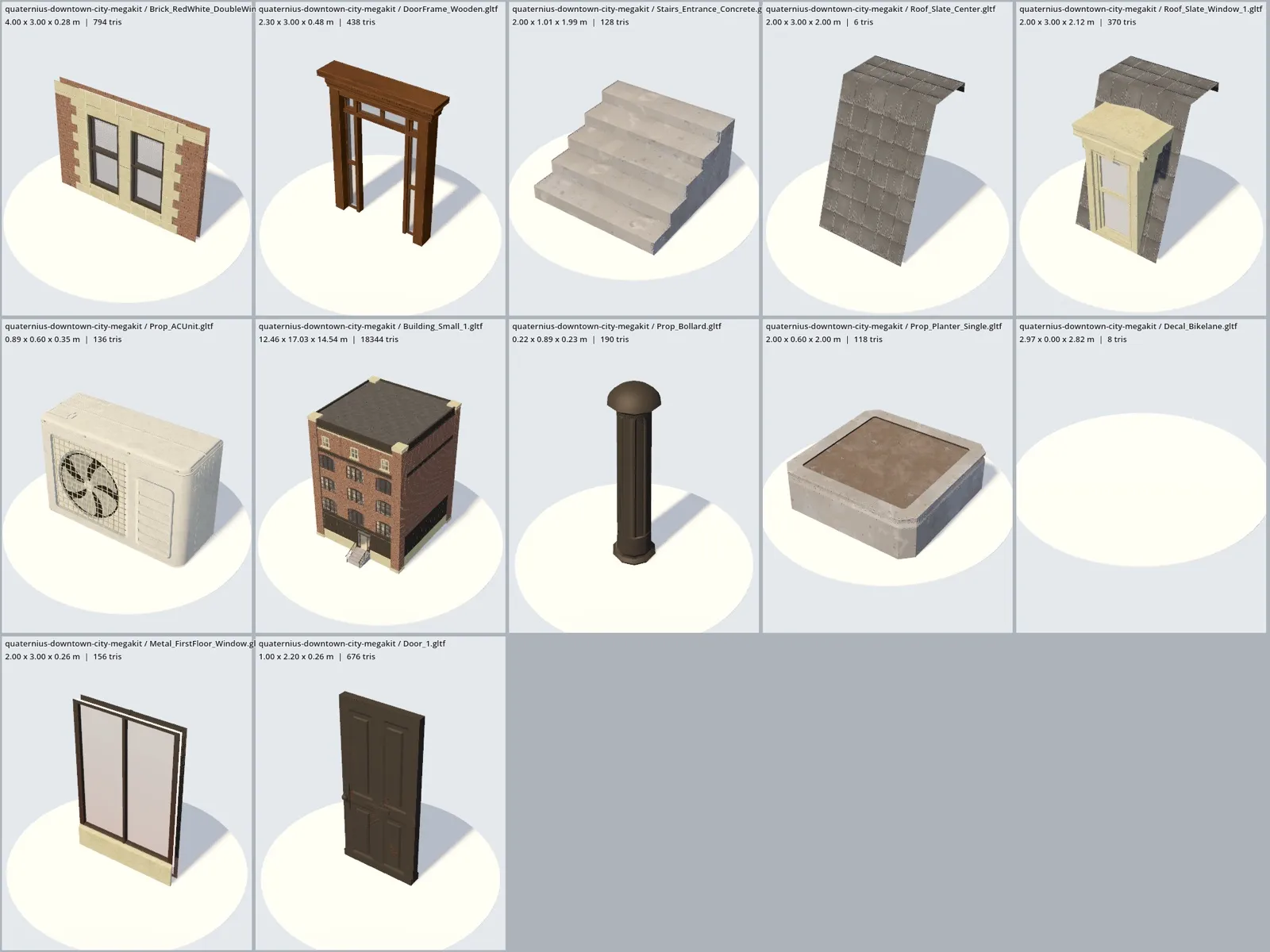
A pack that did not: realistic textures cannot be recoloured from a palette, and they would clash with everything else. The red-brick building alone is over 18,000 triangles.
Vehicles got a different test: a real-scale lineup, with a 1.8 metre red pole at the start of every row, so a van that looks right in a cell but is 9 metres wide shows up straight away.
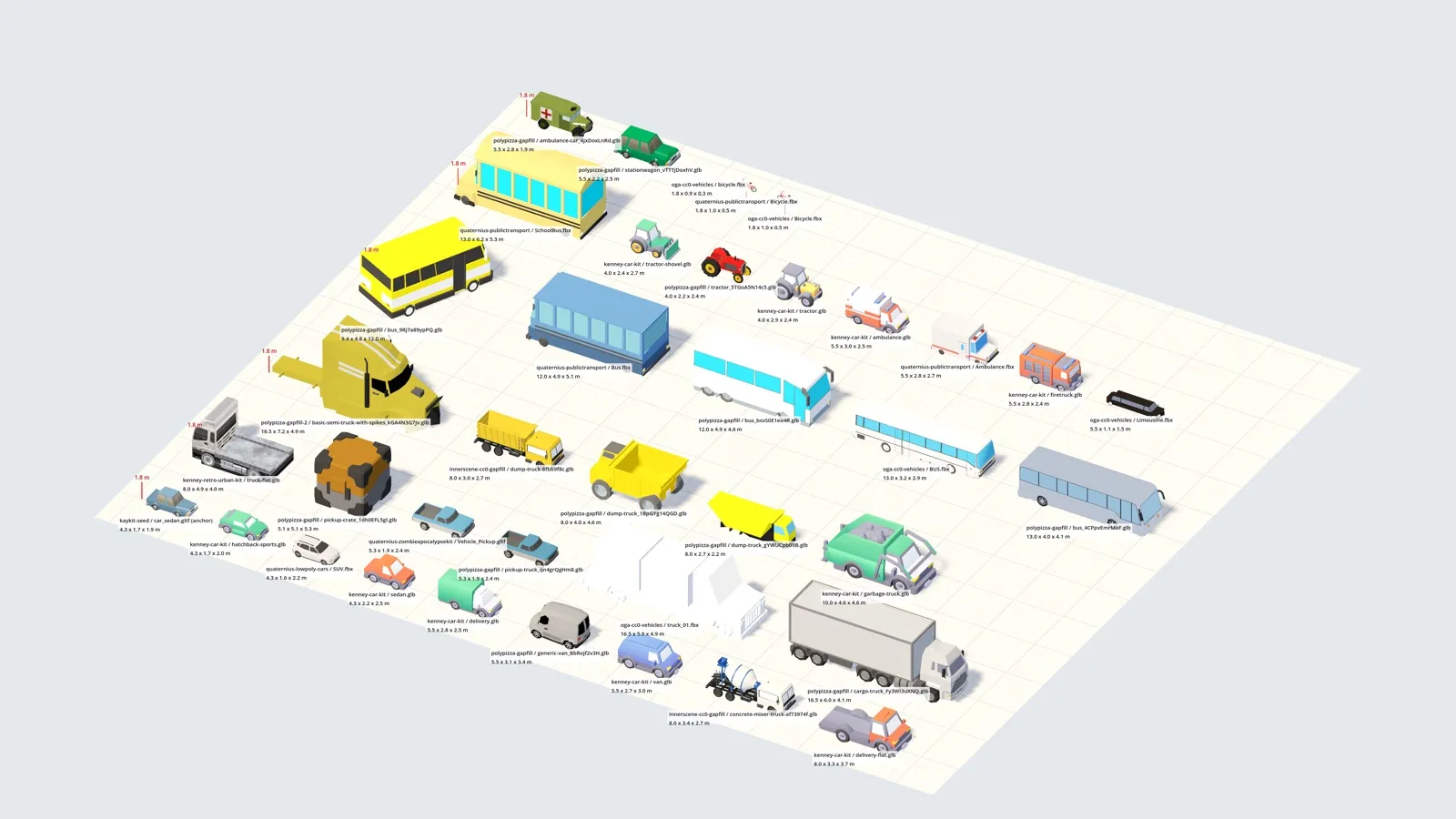
Every vehicle candidate at the same scale. The toy-like ones, with huge wheels, stand out beside the seed cars at the bottom left; the long lorries and coaches are the things I could not find in a matching style. The white shapes are models that lost their colours, which is the next section.
The white models
A good number of attractive models came out plain white on the contact sheets. The cause was not the models: they were made in Blender with their colours stored in a way the usual file formats do not carry, so converting them dropped the colours. The original Blender files are still in the downloads, though, and they are plain files, so I had an assistant read the colours straight out of them and put them back. The pack of public transport, for instance, went from white shapes to red bicycle frames with black tyres and a blue bus.
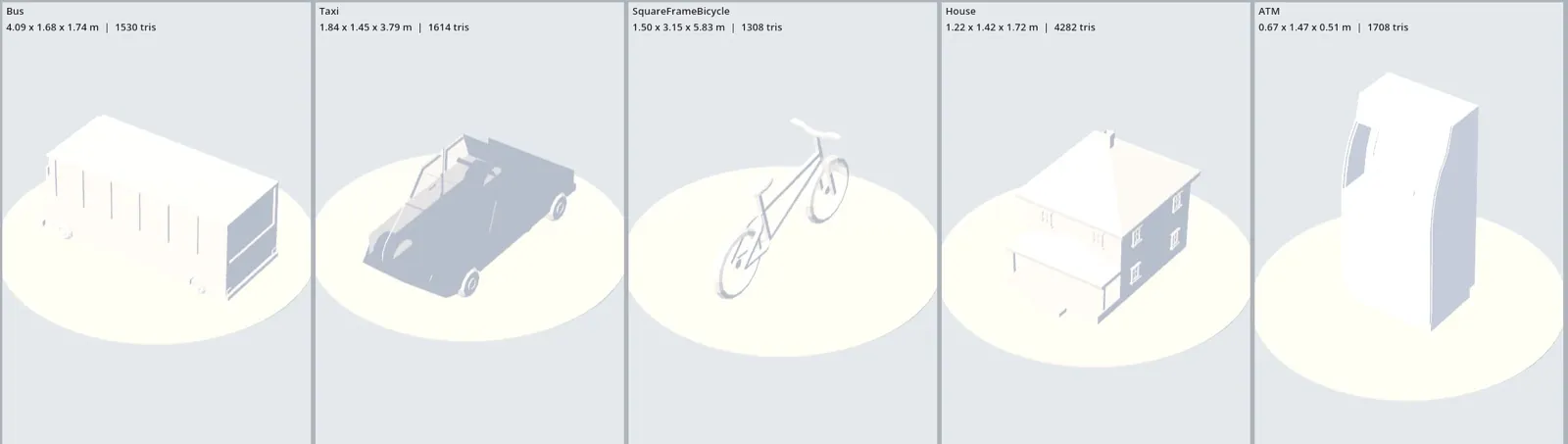
Before: everything white, so there was no way to judge them.
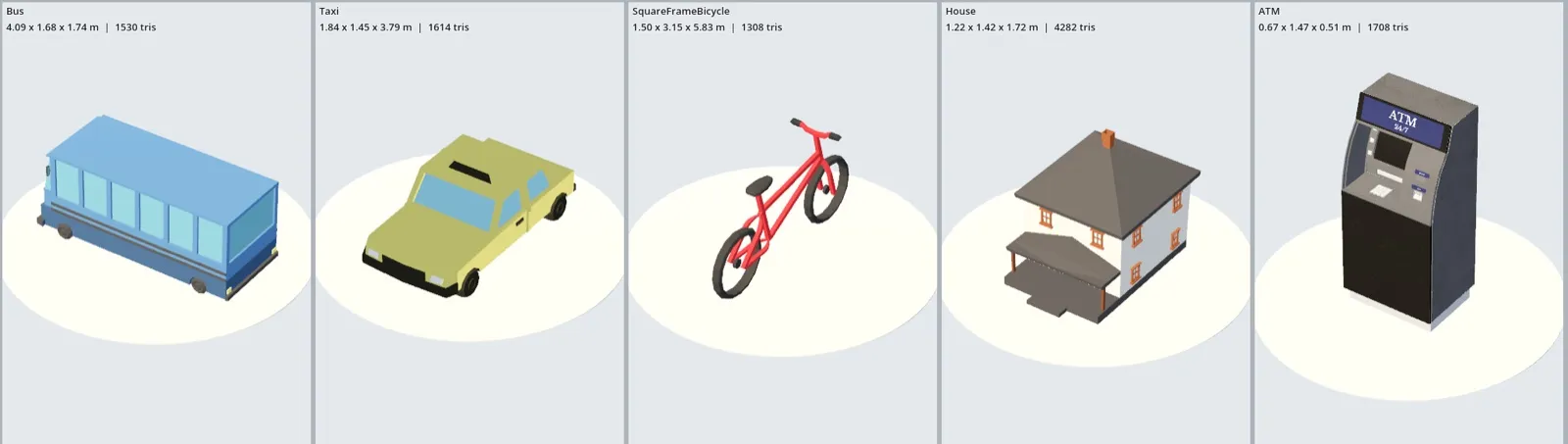
After: the colours are read out of the original files, and the models can be judged for what they are.
Some of the rescued models are in the final list. The bicycle is, and so are glazed windows, an entrance step and a balcony.
What made the cut
82 models made it, in seven groups, from seven packs. 74 are CC0 and 8 are CC-BY; those eight are credited below. The picture at the top shows a cross-section of them together at real size; here they are group by group.
Vehicles first. The honest news is that this group is thin: one small car, a van, a flatbed, a tipper, a tractor, a tractor trailer, a midibus, a compact coach and a bicycle.
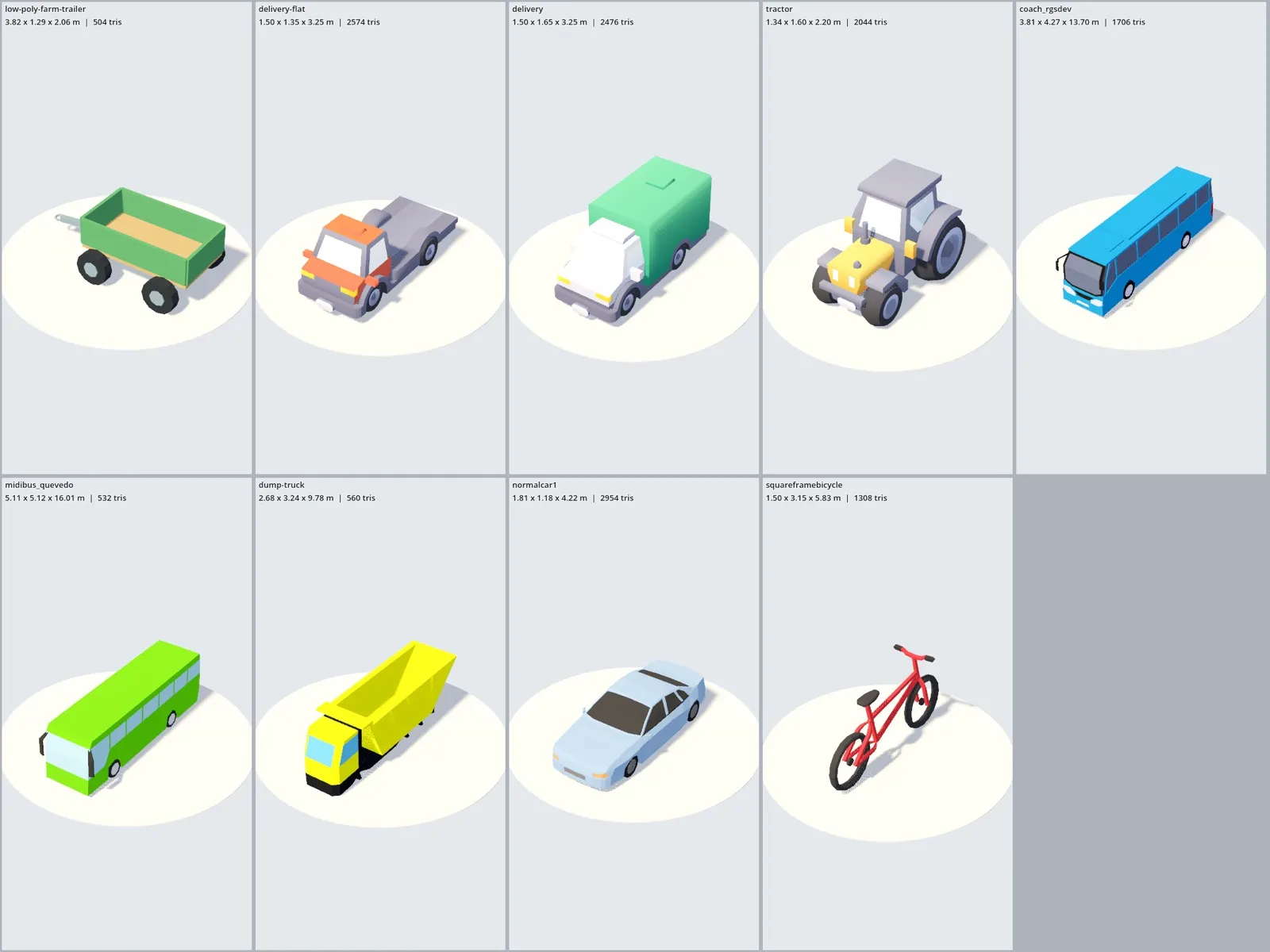
The vehicles. The lime-green bus and yellow tipper are much louder than the town’s colours and will be tinted before they go live. The bus and coach are compact (8 and 9 metres), not the full-size ones a town needs.
Then building parts: the pieces the game’s procedural buildings will wear.
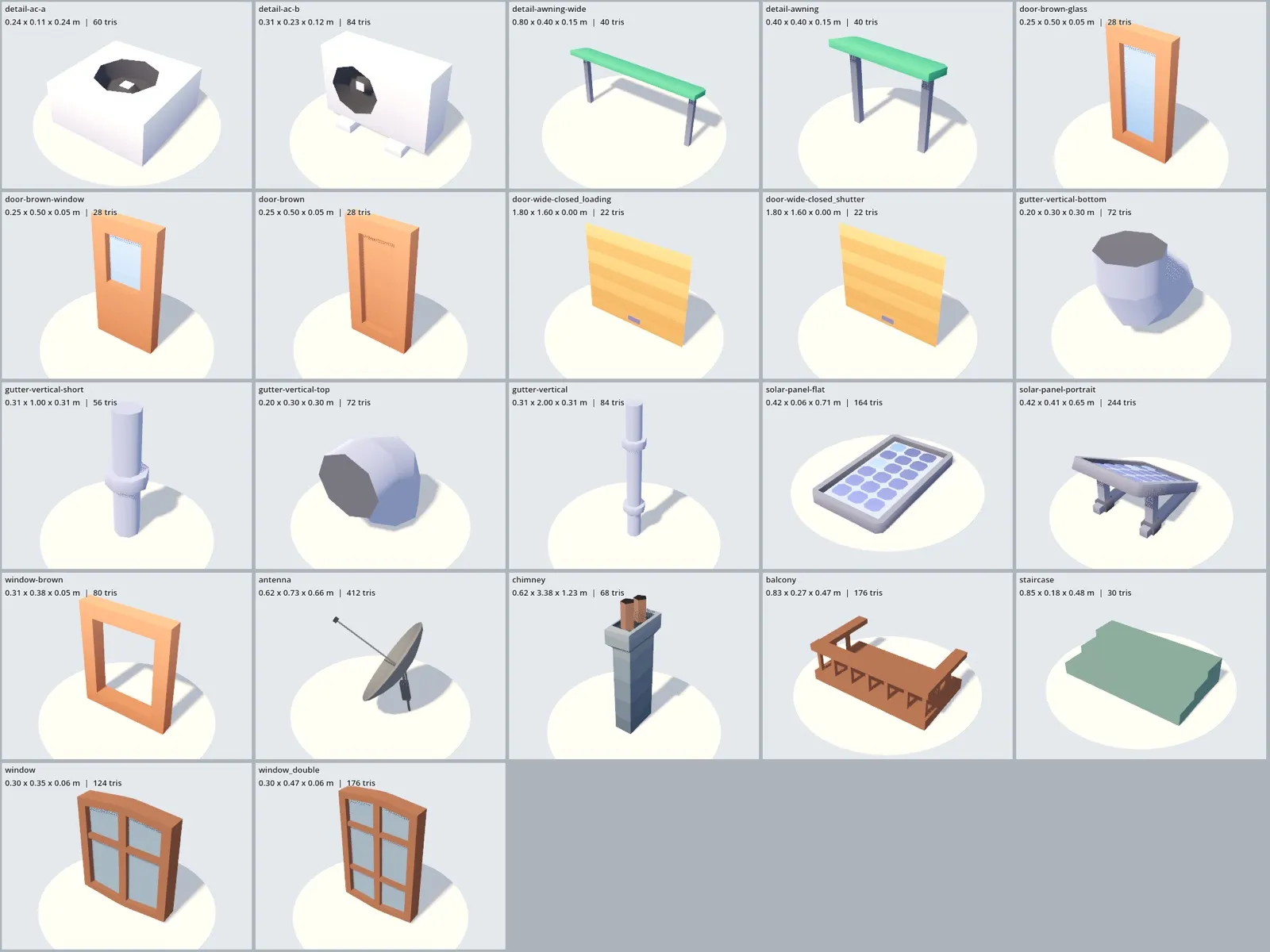
Windows, doors, a roller shutter and a loading door, drainpipes, awnings, solar panels, a chimney, a balcony and entrance steps, all in the same cream and brown family.
Street furniture.
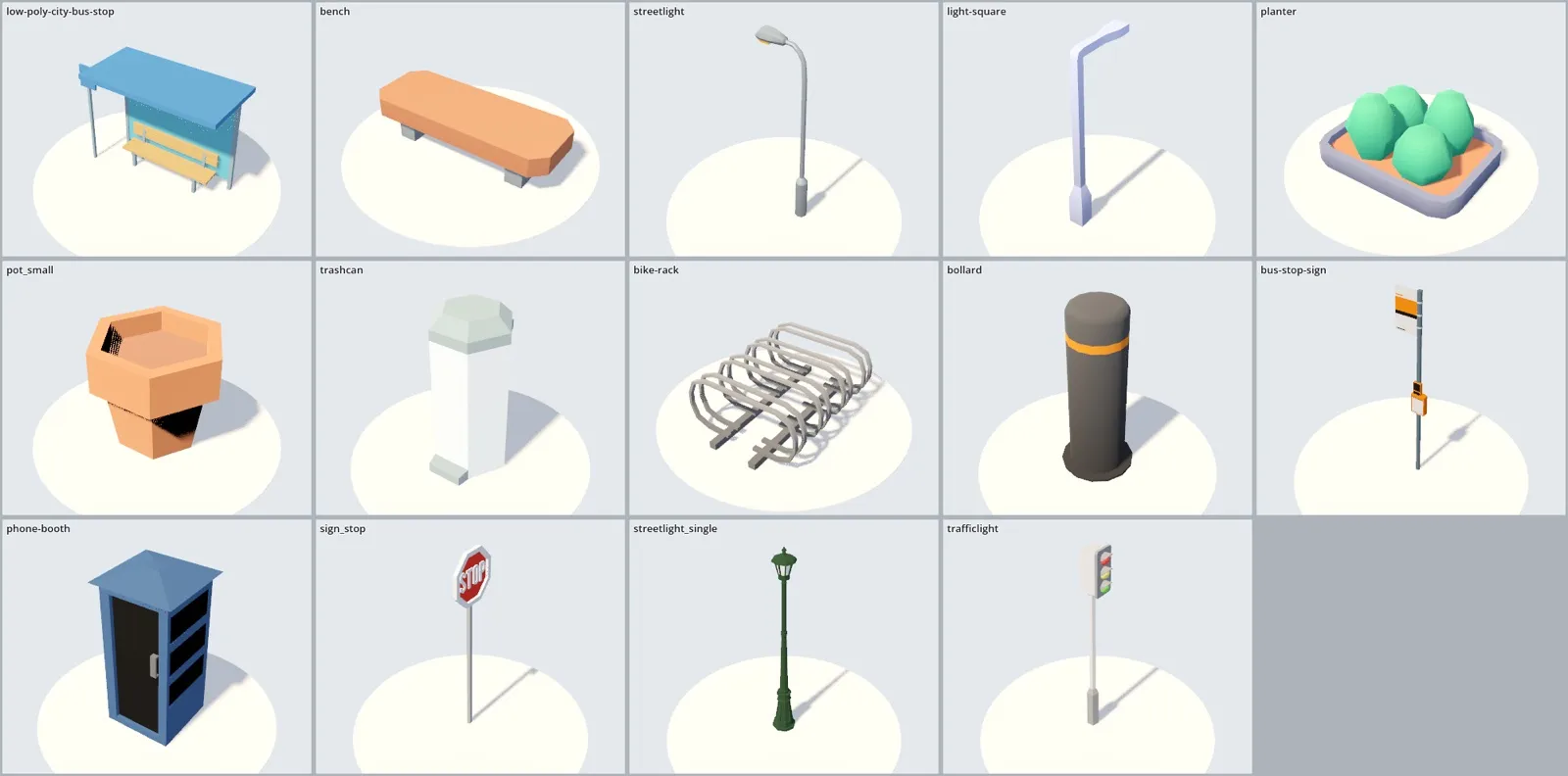
Lamps, a traffic light, a bus stop and shelter, a bench, a bollard, a bin, a phone box, a sign, a cycle rack and planters. The navy phone box is only a stand-in: a red British one is on the missing list.
Farm, construction and people.
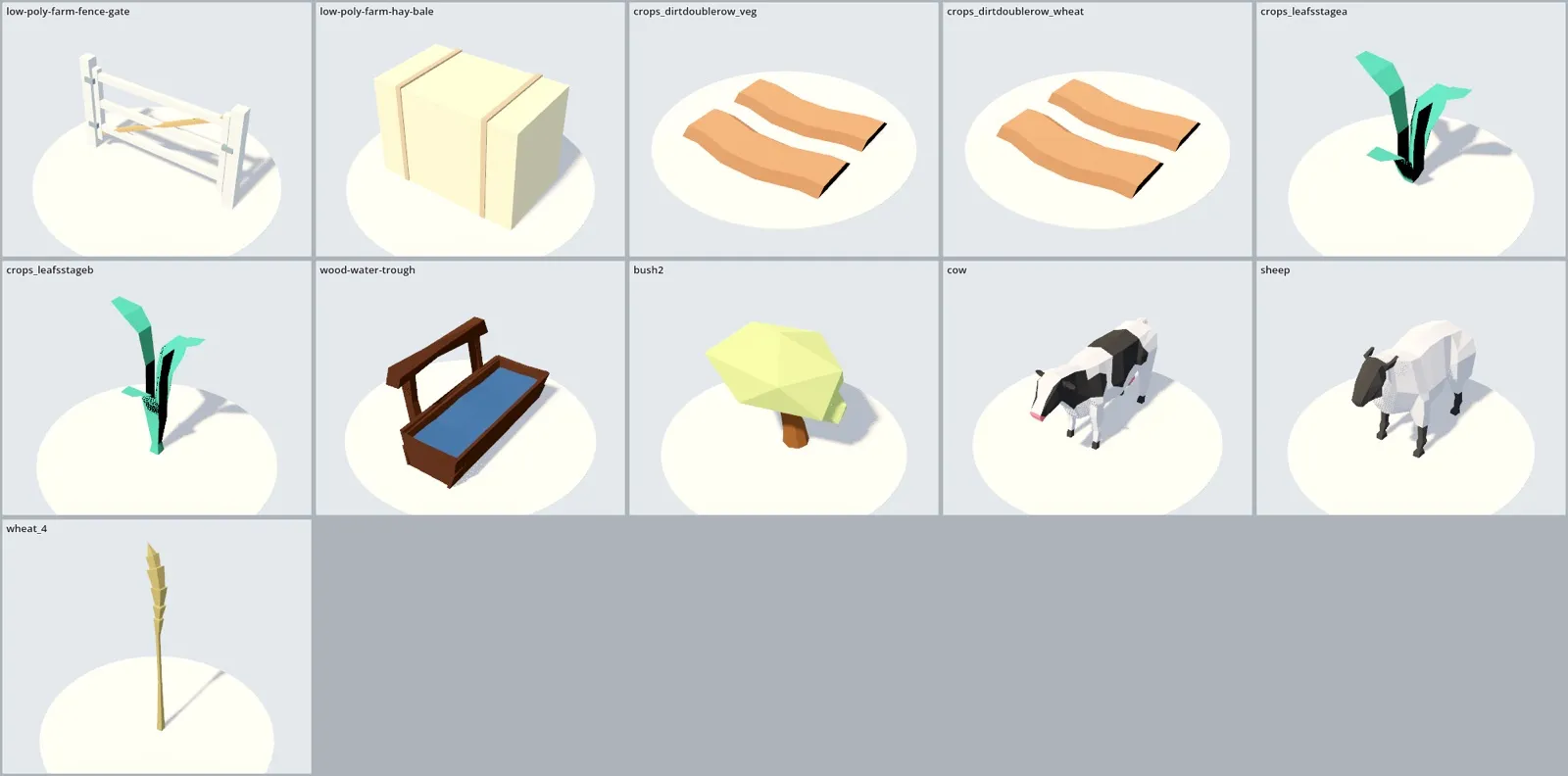
The farm: crop pieces, a hay bale, a trough, a hedge, a gate, and livestock.
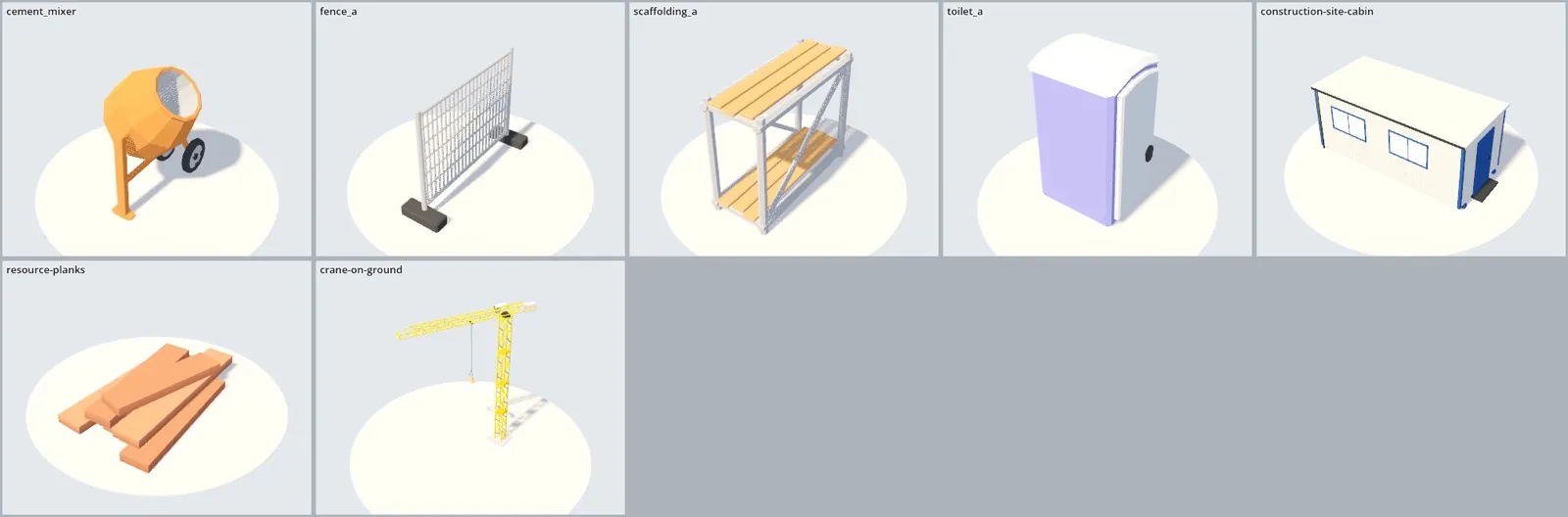
The construction site, from scaffolding to portaloo. The portaloo is lilac, so it will need recolouring.
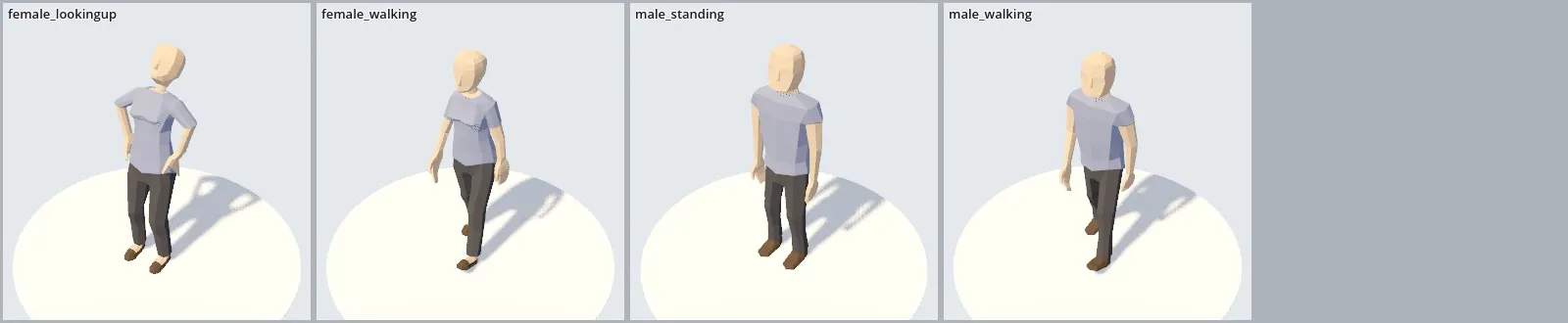
People, at normal adult proportions. They are static poses, not walking animations, so for now they would glide.
What is still missing
There are real gaps, and they are the interesting part. No free set in a matching style has a rigid lorry, an articulated lorry, a concrete mixer, a lorry-mounted crane, a bin lorry of a sensible size, a full-size bus or coach, a hearse or a combine harvester. A red K6 phone box, a post box, a Belisha beacon, sash windows, a British barn, a polytunnel, round bales, dry-stone walls, riders on bikes, walk cycles, and ash and hawthorn trees are also not there.
Some of these are simple enough that the game can draw them from basic shapes itself (bales, post boxes, beacons, polytunnels, walls). Some can be built by combining or cutting down models I already have. Some I will have to commission, and the vehicles are the biggest of those. Once the game is closer to playable, I would rather pay an artist to make the lorry family than stretch a toy truck.
What comes next
The client still only knows trees, ground cover and cars, so the next step is teaching it the other kinds of model, starting with the ones where we already have something good: vans, bicycles, street furniture and building parts. Several colours are loud (the lime bus, the yellow tipper, the orange container and the lilac portaloo), so each model needs its recolouring set up properly before it appears in the town. Then the missing things, one at a time.
Update, 4 November: the first of them are in the town
The game now loads every model on this list by itself, so a new pack only has to be dropped into its folder. Most of them still wait for the game to learn to draw their kind of thing, but three are of kinds it already draws: Kenney’s oak and its slender field tree now grow among the broadleaf trees and along the streets, and the small car from the vehicles picture drives among the others, about one car in fifteen.
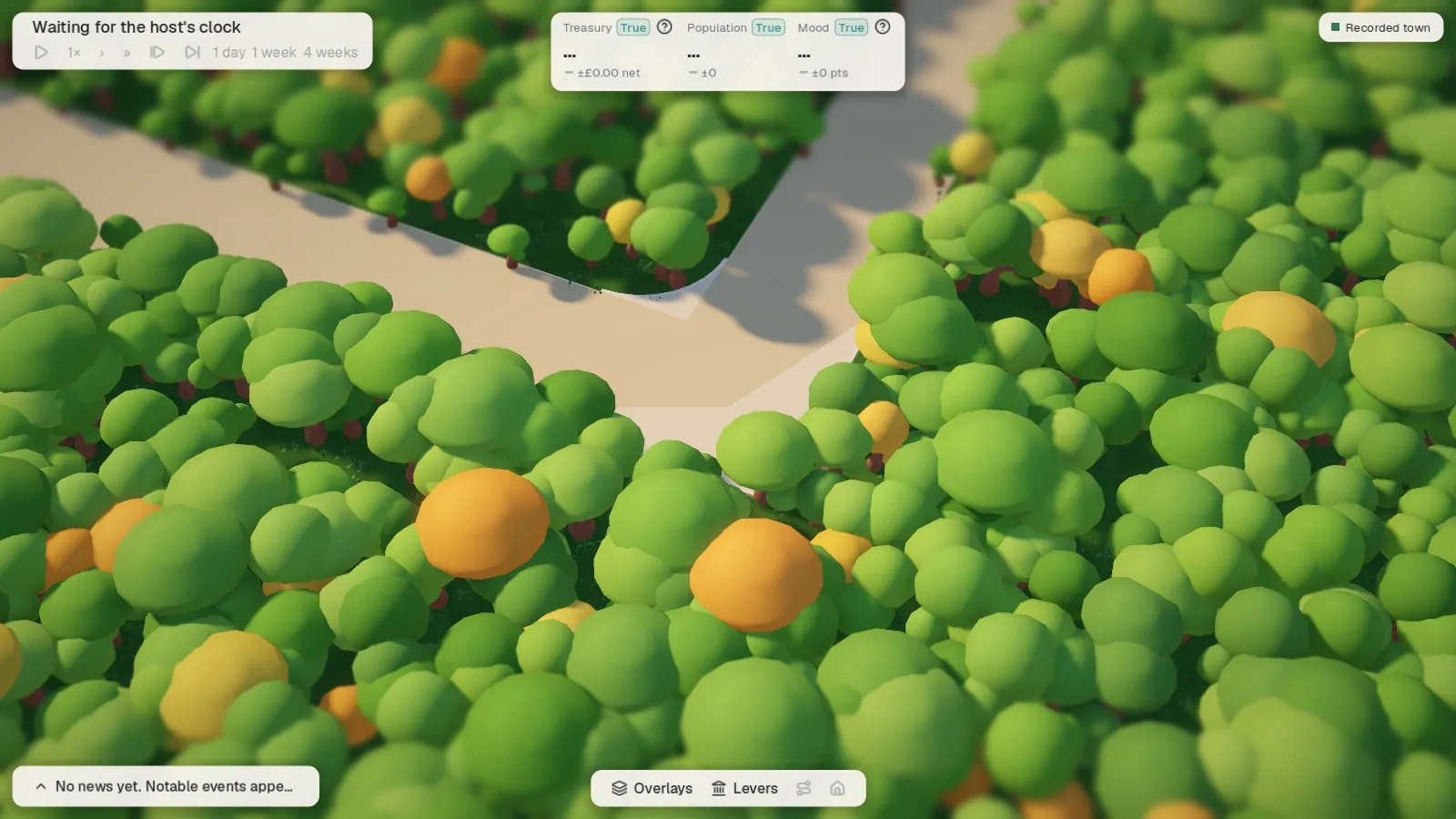
Before: a wooded block near the plaza, every crown soft and rounded.
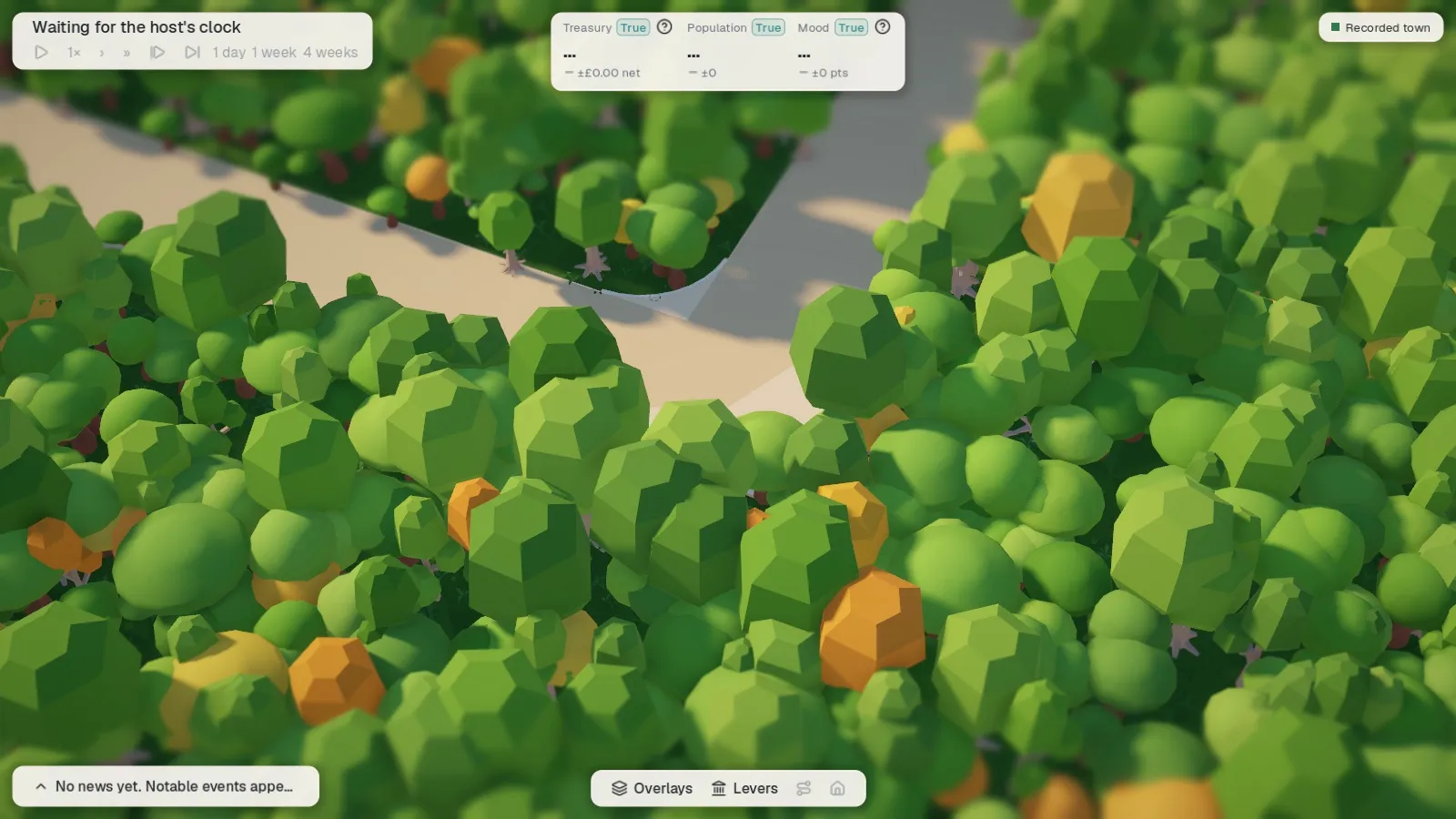
After: the same block with the Kenney trees mixed in, about a third of the broadleaf trees. Look for the flat-sided crowns.
The oak came weighted three times as heavily as every other tree. Once it loaded, that was far too much: it took half the canopy, and its faceted crown and pale trunk stood out beside the soft KayKit trees, so I turned it down to the picture above. An oak that matches the KayKit trees better would still be welcome. The other 79 models are checked every time the game starts, which takes no longer than before, and they appear as the game learns to draw them: street furniture first, then building-site props, then people.
Credits
With thanks to everyone whose work is in this list. Models by Kenney (CC0), Kay Lousberg of KayKit (CC0), Quaternius (CC0), Anker’s Assets (CC0), Innerscene (CC0), and from OpenGameArt Rgsdev and Daniel Quevedo (CC0).
The CC-BY models shown here, from Poly Pizza, are licensed CC-BY 3.0 and are unmodified except for scale:
- “Bike Rack” and “Bollard” by J-Toastie (bike rack, bollard)
- “Bus stop sign” by dook (source)
- “Chimney” by Pixel (source)
- “Dump Truck” by Crachboss32 (source)
- “Phone Booth” by Zsky (source)
- “Wood Water Trough” by Oliver Herklotz (source)
- “Forklift” by KolosStudios (source), part of the final list, though not in a picture above